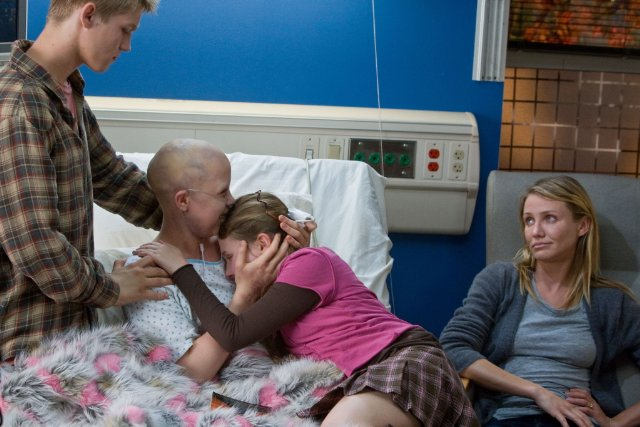
I saw this great film; it was about a girl who...
Admittedly, when we describe a film, we often talk about one central character, usually the character with a weakness that goes on a journey and changes, often called the protagonist. But is the protagonist the only important character? Perhaps the protagonist is the most central character in terms of conflict and theme, but I think it’s better to consider all characters as equally important, something I’ve been able to do better when using Roger Stennett’s five story development questions, which I look at below with examples from the film, My Sister’s Keeper.
Spoilers below.
1. What do I want to say?
As I mentioned in my Down on the Farm post, you’ve really got to have a passion for the story you are telling and have a strong message to express. I can imagine that Jodi Picoult, who wrote the original Novel of My Sister’s Keeper, had a strong sense of what the story was all about.
For those who don’t know, My Sister’s Keeper is all about Anna, who’s engineered cells and tissues are saving her older sister Kate’s life from Leukaemia, who sues her family for the rights to her own body. There are lots of moral questions, but mainly it’s about the mother, Sara, the protagonist, who fights to keep Kate alive, damaging her family and sometimes even preventing Kate from positive life experiences, whilst Anna sues not just for the rights to her body, but for Kate’s right to die. The film asks how far we are willing to go to save a loved one; is it right to put the needs of everyone else, including the one we are protecting, second to our need to keep them alive? What I think is wonderful, is how there are no easy solutions, and finally Sara is forced to let Kate go, giving her what she wants, celebrating the good life she’s lived, and finally bringing her family together.
2. Who are these people?
This question seems to ask about a community, and unless your character is a hermit (but then consider how the community feels about that hermit) they have people in their lives with values. How to Train Your Dragon features a community of tough Viking dragon slayers, and The Firm a community of highflying, intrusive businessmen. My Sister’s Keeper is all about the family unit, and each one is dealing with the care of Kate whilst trying to keep their family together, and it’s through how they go about this that the story and theme unfolds.
3. What do they want?
Sara wants to keep Kate alive and well, whereas Anna wants to sue her parents for the rights to her own body, until it’s then revealed she, along with her brother Jesse, wants to help Kate to die. Brian, Sara’s husband initially helps with Kate’s treatment, but then he discharges Kate to take her to the beach against Sara’s wishes, showing his allegiance to Anna and Jesse.
Everyone wants something and side under two distinct moral points of view, to let Kate live or die, but overall everyone wants to keep their family together and each go separate ways to achieve it.
4. What stops them getting it?
The film is based upon the idea that Sara would never allow Kate to die, and Anna has to get the rights to her body to make that decision. We have the scenes in the court room involving Campbell, Anna’s lawyer, and Judge De Salvo, who is dealing with her own grief. I love how the family are all in opposition, but still sit around the dinner table together, attempting to function as best they can as a normal family despite the conflicts bubbling under the surface.
5. Why should I care?
This is hard question to answer. “It’s my story, of course you should care!” I think it’s about the stakes of the film, what happens if the characters should fail. If Anna doesn’t get the rights to her body she will have to undergo several operations. It’s horrible to think that a child should have to do that, and we care because there is something moral going on here and a person could get hurt.
I also think we care when we empathise with the situation. We don’t like Sara for doing what she’s doing to Anna, but we understand the lengths a mother would go to save her daughter. If a character does something morally wrong yet we get why they are doing it, I think we are gripped. We start to question the way we view the world. What is right or wrong? That’s what a great film or story is supposed to do. Make use reassess the way we view the world, and come out feeling changed ourselves. That’s why we should care, because this film is saying something important.
I thought I’d wrap up with my inspiration to this post. I read an article describing the primary character and secondary characters, with a warning not to reveal too many surprises about the secondary characters as this might distract from the primary character. Although I do agree that we don’t want to dilute the film too much or else it could lose its focus on the protagonist’s journey, we, as writers shouldn’t think in a black and white sense of primary and secondary. All the character’s in My Sister’s Keeper serve the change in Sara’s character through added texture and colour. Even if certain aspects of character don’t make the final cut, it’s good to know all your characters inside out, and to remember that all characters are central to the story with their own unique purpose.
You can read more about screenwriter, dramatist and director Roger Stennett, on his website
The journey of a writer, scriptwriter and poet, and tips on how to survive the new writing scene
Showing posts with label Writing Great Characters. Show all posts
Saturday, 13 July 2013
Wednesday, 26 June 2013
How to Make Your Monologue Dramatic; Emerging Writer’s Workshop Two
I’ve written a few monologues before, but all have read like a sprawl of thought slammed onto the page, poorly written and certainly not dramatic. Thankfully, Angela Street showed me and the rest of her Emerging Writer’s Workshop how to make a more engaging monologue through three simple steps, giving us the confidence to rewrite our attempts.
1. Is your central character doing something to someone?
This forms the basic action of the scene; what your character is doing. The prisoner struggles to persuade the interrogator of his innocence. The boyfriend tries to apologise to his girlfriend. A patient struggles to hide their pain and convince a loved one of their comfort. It’s much like a scene in any film or play, except the character cannot just be retelling a story, or else they are a narrator, saying what happened instead of trying to achieve a goal.
Before the class had even begun, Angela tasked us with writing a monologue inspired by bits of fluff and glitter left on the floor by an earlier art and craft session. I was a bit nervous as we only had a few minutes, and ended up writing a fantasy story about a father’s mistake.
Rather than addressing the audience, this is just the father’s internal thoughts. If he spoke to us as if a friend, for example, it could work, but only if he tried to do something to that friend, perhaps justifying an action, such as to hide the dead fairy and conceal the truth.
2. Why is your character saying it now?
In Dial M for Murder, Tony decides to kill his wife Margot because of the secret affair he discovers she had with Mark, who is now right under his nose. A character must act for a reason. Perhaps they have witnessed something shocking, or need to borrow money after losing a job, and must turn to a parent without appearing to be a failure. My attempt seems obvious; he’s just killed a fairy by accident, but why? If he hasn’t believed in fairies his whole life, why is this the first to die? Are they in a new house near fairies? Or, has he had the time to play along with his daughter’s ideas until a new project at work stole his attention, repressing his imagination to the point that he no longer played along with her beliefs?
3. Who is your character speaking to?
You might have already done this when considering your character’s basic action, but you need to know who your character is speaking to. It could be a radio show, a board-room meeting, or an alien communicating with the mother-ship. It could be anything, so long as one character is doing something to another. In my example, I could put someone in the room with him, such as his daughter, and have him conceal the truth and make up excuses on the spot, or it could be him telling a friend about the situation. In the latter example, he needs to be doing something other than telling. Perhaps his daughter came in and he made out he’d spilt an art and craft kit, and allowed her to use the glitter/fairy entrails to finish the birthday card she’d started to make her fairy friend, and Dad is now struggling to justify his actions to a friend, trying to make out that he was protecting her from a painful truth.
I recently heard a great monologue on a radio play called, The Interrogation, which started with a husband telling the story of how he lost the trust of his wife after an accident hurt his child, and how he now felt like a stranger in his own home. What made it work was how it revealed the husbands violent outbursts towards his wife and how he didn’t want to admit he was a bad man.
These three steps have already given me an idea on how to rewrite my monologue. It’s all very new to me, but underneath are the same principles of storytelling, though this form seems more about how the words themselves are actions; tools in your characters’ arsenal to get what they want. Hopefully, practice with the characters I’m currently writing will not only reveal more about them, but hone my dialogue skills as well.
You can find out more about Angela Street and her writing workshops on her website.
Subscribe to Radio 4’s Drama of the Week to listen to future episodes.
1. Is your central character doing something to someone?
This forms the basic action of the scene; what your character is doing. The prisoner struggles to persuade the interrogator of his innocence. The boyfriend tries to apologise to his girlfriend. A patient struggles to hide their pain and convince a loved one of their comfort. It’s much like a scene in any film or play, except the character cannot just be retelling a story, or else they are a narrator, saying what happened instead of trying to achieve a goal.
Before the class had even begun, Angela tasked us with writing a monologue inspired by bits of fluff and glitter left on the floor by an earlier art and craft session. I was a bit nervous as we only had a few minutes, and ended up writing a fantasy story about a father’s mistake.
Was I too late? Did I not say the words in time? These stars; her ashes, poor little ashes are all that remains of her. I didn’t believe, I didn’t want to believe, and my imaginative lack the chain that choked her life away. Is this how they all end, in a puddle on the floor, from long life or from the likes of me, a disbeliever, chanting with refuses of, “they don’t exist.” Such childishness. She was right, and Christ she’ll be back soon. Could I say I spilled some art and craft kit? Perhaps a sign, yes for Aunt Jude’s birthday – but what sign? Do I have time to make one? Or will she know? She knew a lot; she must know how fairies reach their end.
Rather than addressing the audience, this is just the father’s internal thoughts. If he spoke to us as if a friend, for example, it could work, but only if he tried to do something to that friend, perhaps justifying an action, such as to hide the dead fairy and conceal the truth.
2. Why is your character saying it now?
In Dial M for Murder, Tony decides to kill his wife Margot because of the secret affair he discovers she had with Mark, who is now right under his nose. A character must act for a reason. Perhaps they have witnessed something shocking, or need to borrow money after losing a job, and must turn to a parent without appearing to be a failure. My attempt seems obvious; he’s just killed a fairy by accident, but why? If he hasn’t believed in fairies his whole life, why is this the first to die? Are they in a new house near fairies? Or, has he had the time to play along with his daughter’s ideas until a new project at work stole his attention, repressing his imagination to the point that he no longer played along with her beliefs?
3. Who is your character speaking to?
You might have already done this when considering your character’s basic action, but you need to know who your character is speaking to. It could be a radio show, a board-room meeting, or an alien communicating with the mother-ship. It could be anything, so long as one character is doing something to another. In my example, I could put someone in the room with him, such as his daughter, and have him conceal the truth and make up excuses on the spot, or it could be him telling a friend about the situation. In the latter example, he needs to be doing something other than telling. Perhaps his daughter came in and he made out he’d spilt an art and craft kit, and allowed her to use the glitter/fairy entrails to finish the birthday card she’d started to make her fairy friend, and Dad is now struggling to justify his actions to a friend, trying to make out that he was protecting her from a painful truth.
I recently heard a great monologue on a radio play called, The Interrogation, which started with a husband telling the story of how he lost the trust of his wife after an accident hurt his child, and how he now felt like a stranger in his own home. What made it work was how it revealed the husbands violent outbursts towards his wife and how he didn’t want to admit he was a bad man.
1. Is your central character doing something to someone? His basic action was to justify his violence to the audience and himself.
2. Why is your character saying it now? His estrangement had bubbled to the point of him striking his wife.
3. Who is your character speaking to? This was a little vague, though I could imagine he was talking to a friend, or perhaps this is the argument he later tells the police.
These three steps have already given me an idea on how to rewrite my monologue. It’s all very new to me, but underneath are the same principles of storytelling, though this form seems more about how the words themselves are actions; tools in your characters’ arsenal to get what they want. Hopefully, practice with the characters I’m currently writing will not only reveal more about them, but hone my dialogue skills as well.
You can find out more about Angela Street and her writing workshops on her website.
Subscribe to Radio 4’s Drama of the Week to listen to future episodes.
Monday, 27 May 2013
Finding your Character’s Voice: Angela Street's Role-Play Exercise
Last week at the Salisbury Playhouse, I went to the first summer term class of playwright and mentor Angela Street’s Emerging Writer’s Workshop, which aims to nurture new writers and provide a platform to discuss opportunities, successes and how to overcome physical writing problems. We looked at how to avoid on the nose dialogue and how to find and write the unique voice of characters by using an interactive role-play task.It’s important to have each of your characters speak differently. A limp and an eye-patch as Blake Snyder liked to say. What you certainly don’t want is every character to sound like you. They are individuals, and you need to express their unique attributes on the page.
To get inside the head of our characters, Angela had us write a few pages of their interior monologue, then write a few interesting facts about them and what they’re afraid of.
The role-play needed two people to have a conversation, answering and speaking as their characters as if they were stuck in a lift together. We weren’t allowed to tell each other about our characters, everything had to come out of the dialogue. This presented a few problems, mainly gender and race; all the observable qualities of character. My role-play partner took a while to figure out my character, Fran, was a girl, and that changed the tone of dialogue considerably. It was interesting though, as my character is a bit of a tom-boy, so perhaps this is something that could happen to her, like Arya in Game of Thrones.
I did have a few surprises. The character in the lift with me was a drunken defeatist, and Fran told him off for swearing and drinking. When the lift started to smoke (an action given by Angela who was supervising the exercise) Fran sprang to life and tried to figure out a way to get them out the lift. So I learnt she’s morally strict, resourceful, and a natural leader.
Doing this exercise can show you how well you know your characters and indicate if you need to do more development. I found it hard to think of what to say, and most of the dialogue was simple hellos and Fran commenting on things going on around her. I think it showed I didn’t know her very well, which isn’t surprising as she’s a new character.
I think next time I would specify the setting a bit more. As the lift was just a random lift with no indication of the type of building, city, town, country. I found it hard to think of how she would react to things around her. It was hard also not really knowing why she was in the building in the first place, so perhaps a few useful things, such as, it’s a gratified lift in an apartment block, or it’s an immaculate shinny lift with a sofa, each indicating the type of building and person she might meet, enhancing dialogue with values, and possibly conflict.
It’s important to understand your characters personality if you want to capture their unique voice. This role-play can help you imagine what they’re like, what they value, what they desire and what they’re afraid of. I’ve never taken much stock in writing a character bio with every detail including favourite type of cereal and TV show (if they even like cereal or TV), but I suppose it is useful to try and think of more than the bare bones of story and spend a bit of time hanging-out with characters, learning as we do with a new friend what it is that makes them who they are.
The next Emerging Writer’s Workshop takes place on the 15th June, where Angela will be looking at a sample of our dialogue to give us useful tips. You can find more details on Angela Street and her upcoming courses (including a summer residential in Salisbury) on her website.
Friday, 17 May 2013
Witty Dialogue in Double Indemnity
Besides drafting a one page treatment for my new play, (which I realised is an ugly new-born baby) I’ve spent my spare time this week catching up on a few films. Firstly, Kiki’s Delivery Service from Studio Ghibli, a wonderfully uplifting story of a young witch coming of age when she trains away from home for a year to develop her powers. I highly recommend it. I also watched Double Indemnity for the first time, and was really impressed with how the characters set up the story with only a few lines directly stating their intentions, creating dialogue with depth and intrigue. In this post I look at DI (okay yes a highly looked at film) but also talk about my experience of writing dialogue and how I’ve tried to improve it.
Alexander Mackendrick’s great film, the Sweet Smell of Success, is another example of great dialogue, and in his book, On Film-Making, Mackendrick says that dialogue works best when the emphasis isn’t on the words but the ‘real intentions and motivations of the characters.’ In this way, it might be better for a character to talk around what they want or mean to say, encouraging the audience to dig beneath the surface.
The following extract is from the beginning of DI on the second visit that protagonist, Walter Neff, an avid insurance salesman, makes to client Phyllis Dietrichson, who is enquiring about accident insurance for her husband, but her dialogue creates the feeling that she's really talking about something else.
NEFF
Wait a minute. Why shouldn't he know?
PHYLLIS
Because I know he doesn't want accident insurance. He's superstitious about it.
NEFF
A lot of people are. Funny, isn't it?
And then a few lines later…
NEFF
Of course, it doesn't have to be a crown block. It can be a car backing over him, or he can fall out of an upstairs window. Any little thing like that, as long as it's a morgue job.
PHYLLIS
Are you crazy?
NEFF
Not that crazy. Goodbye, Mrs. Dietrichson.
PHYLLIS
What's the matter?
NEFF
Look, baby, you can't get away with it.
PHYLLIS
Get away with what?
NEFF
You want to knock him off, don't you, baby.
The dialogue is bouncy and witty mainly because we can tell something else is going on, and then we get that line at the end which acts as a dramatic full stop, a direct line to make her intentions crystal clear. Phyllis then visits Neff at his apartment to return his hat.
NEFF
How were you going to do it?
PHYLLIS
Do what?
NEFF
Kill him.
PHYLLIS
Walter, for the last time –
“You want to knock him off,” and “Kill him,” are the only direct references in the entire set-up of the film. This scene is great because instead of saying, “you know how hard it’ll be,” he just reels off past examples where people have failed to fake a claim. She says how hard it is for her in her relationship, whilst still denying her intentions, and then finally, Neff, whose dialogue and voice-over has implied his desire for her, agrees to help.
NEFF
-- you're not going to hang, baby. Not ever. Because you're going to do it the smart way. Because I'm going to help you.
I can’t claim to have written anything nearly as exciting as that, but here’s an example of a line that came out very on the nose at first and had to be tweaked. It’s set in a diner where the protagonist, Steve, stops whilst on his way to a Native Indian Reservation, where he will discover lots of things he didn’t know about his recently deceased ex-wife, Justine. In this scene, he finds she became a great painter, and I thought it’d be cool to have someone make it clear these were painted by Justine and imply a few things about who she had become.
WAITRESS
Yeah, by a real famous local artist. A saint of a woman. Sad story though. She died recently.
And later changed to…
WAITRESS
Yeah, Hounslow’s. We love ‘em. I saw her in Santa Fe. She’s a hippy volunteer type, but lovely though.
The first example was on the nose, as it heavily states, yes, we’re talking about your ex-wife who recently died, duh. The second is a bit more natural. It implies Santa Fe, a very arty place, and how wonderful (and different to Steve’s expectations) that Justine is.
It’s Justine, dead, but still looking beautiful. Steve studies her and notices a braid in her hair, turquoise earrings and a necklace, and native markings on her skin. Lisa takes Steve’s hand and squeezes.
Steve just stares at Justine’s body.
STEVE
She looks so...
LISA
Peaceful.
STEVE
Yeah. She looks peaceful.
That’s probably one of my favourite lines. I think it reveals Steve’s true reaction without actually saying it, though because of what we know about Steve, we understand what’s really going on.
Witty dialogue isn’t just people saying cool stuff all the time, like when Neff flirts with Phyllis (although this again is a fantastic example of talking around what you truly mean).
PHYLLIS
There's a speed limit in this state, Mr. Neff. Forty-Five miles an hour.
NEFF
How fast was I going, officer?
PHYLLIS
I'd say about ninety.
What it seems more about is having characters a little more indirect (remembering they are their own people, not just a device to get across the story), perhaps saying the opposite of what they truly mean whilst implying what they think. Mrs Dietrichson being concerned about her husband having accident insurance whilst her questions state otherwise, or Steve look like he’s about to say one thing, but says another. Doing this might draw an audience in by making them have to dig a little deeper beneath the surface, and it certainly does make for a more entertaining film.
Can you think of any more examples of films with witty dialogue, perhaps less well known ones than this? If you can (or disagree with my ranting), tell me in the comments section.
Read Double Indemnity script here
Check out Mackendrick's book, On Film-Making, here
Read the Sweet Smell of Success script here
Alexander Mackendrick’s great film, the Sweet Smell of Success, is another example of great dialogue, and in his book, On Film-Making, Mackendrick says that dialogue works best when the emphasis isn’t on the words but the ‘real intentions and motivations of the characters.’ In this way, it might be better for a character to talk around what they want or mean to say, encouraging the audience to dig beneath the surface.
The following extract is from the beginning of DI on the second visit that protagonist, Walter Neff, an avid insurance salesman, makes to client Phyllis Dietrichson, who is enquiring about accident insurance for her husband, but her dialogue creates the feeling that she's really talking about something else.
NEFF
Wait a minute. Why shouldn't he know?
PHYLLIS
Because I know he doesn't want accident insurance. He's superstitious about it.
NEFF
A lot of people are. Funny, isn't it?
And then a few lines later…
NEFF
Of course, it doesn't have to be a crown block. It can be a car backing over him, or he can fall out of an upstairs window. Any little thing like that, as long as it's a morgue job.
PHYLLIS
Are you crazy?
NEFF
Not that crazy. Goodbye, Mrs. Dietrichson.
PHYLLIS
What's the matter?
NEFF
Look, baby, you can't get away with it.
PHYLLIS
Get away with what?
NEFF
You want to knock him off, don't you, baby.
The dialogue is bouncy and witty mainly because we can tell something else is going on, and then we get that line at the end which acts as a dramatic full stop, a direct line to make her intentions crystal clear. Phyllis then visits Neff at his apartment to return his hat.
NEFF
How were you going to do it?
PHYLLIS
Do what?
NEFF
Kill him.
PHYLLIS
Walter, for the last time –
“You want to knock him off,” and “Kill him,” are the only direct references in the entire set-up of the film. This scene is great because instead of saying, “you know how hard it’ll be,” he just reels off past examples where people have failed to fake a claim. She says how hard it is for her in her relationship, whilst still denying her intentions, and then finally, Neff, whose dialogue and voice-over has implied his desire for her, agrees to help.
NEFF
-- you're not going to hang, baby. Not ever. Because you're going to do it the smart way. Because I'm going to help you.
I can’t claim to have written anything nearly as exciting as that, but here’s an example of a line that came out very on the nose at first and had to be tweaked. It’s set in a diner where the protagonist, Steve, stops whilst on his way to a Native Indian Reservation, where he will discover lots of things he didn’t know about his recently deceased ex-wife, Justine. In this scene, he finds she became a great painter, and I thought it’d be cool to have someone make it clear these were painted by Justine and imply a few things about who she had become.
WAITRESS
Yeah, by a real famous local artist. A saint of a woman. Sad story though. She died recently.
And later changed to…
WAITRESS
Yeah, Hounslow’s. We love ‘em. I saw her in Santa Fe. She’s a hippy volunteer type, but lovely though.
The first example was on the nose, as it heavily states, yes, we’re talking about your ex-wife who recently died, duh. The second is a bit more natural. It implies Santa Fe, a very arty place, and how wonderful (and different to Steve’s expectations) that Justine is.
It’s Justine, dead, but still looking beautiful. Steve studies her and notices a braid in her hair, turquoise earrings and a necklace, and native markings on her skin. Lisa takes Steve’s hand and squeezes.
Steve just stares at Justine’s body.
STEVE
She looks so...
LISA
Peaceful.
STEVE
Yeah. She looks peaceful.
That’s probably one of my favourite lines. I think it reveals Steve’s true reaction without actually saying it, though because of what we know about Steve, we understand what’s really going on.
Witty dialogue isn’t just people saying cool stuff all the time, like when Neff flirts with Phyllis (although this again is a fantastic example of talking around what you truly mean).
PHYLLIS
There's a speed limit in this state, Mr. Neff. Forty-Five miles an hour.
NEFF
How fast was I going, officer?
PHYLLIS
I'd say about ninety.
What it seems more about is having characters a little more indirect (remembering they are their own people, not just a device to get across the story), perhaps saying the opposite of what they truly mean whilst implying what they think. Mrs Dietrichson being concerned about her husband having accident insurance whilst her questions state otherwise, or Steve look like he’s about to say one thing, but says another. Doing this might draw an audience in by making them have to dig a little deeper beneath the surface, and it certainly does make for a more entertaining film.
Can you think of any more examples of films with witty dialogue, perhaps less well known ones than this? If you can (or disagree with my ranting), tell me in the comments section.
Read Double Indemnity script here
Check out Mackendrick's book, On Film-Making, here
Read the Sweet Smell of Success script here
Friday, 10 May 2013
When the Cool Character of Your Story Isn’t Your Hero
Sometimes you dream up an amazing character with a really gripping struggle, and then, as I’m sure as happened with the BBC’s latest zombie drama, In the Flesh, you realise they’re not your hero. This post analyses the first episode and looks at how to write a story about an interesting character through the eyes a character you might have overlooked.
Dominic Mitchell’s, In the Flesh, was developed after submission to the BBC Writer’s Room Northern Voices scheme. It became a three-part series, though I felt there needed to be a lot more episodes (unless there’s a season two?), but regardless, the first episode was bit of a gem. Spoilers follow, so if you like you can read the script here as it’s no longer on BBC iPlayer.
Episode one follows Kieren, a Partially Deceased Syndrome Sufferer (PDS), which basically means zombies walked the earth and were then treated with a special drug to restore brain function, controlling their rabid urges, and allowing them to reintegrate into society.
At least, that was the plan. Kieren is sent back to his home in Roarton, where, unlucky for him, the Human Volunteer Force (HVF) is determined to kill zombies, rabid or otherwise. Kieren is forced to hide in his bedroom for fear of his life. This is where Kieren’s sister, Jem, a metal loving teenage badass and respected member of the HVF, takes over the story.
Jem has a meeting with slightly crazed HFV leader, Bill, who states that he will kill any PDS zombie he finds, and as Jem’s family are planning Kieren’s arrival, we get a sense that she’s caught between the values of her HVF buddies and the love she once had for Kieren.
Jem’s goal isn’t very tangible, but she does interrogate Kieren for proof that he is her brother and not just a monster. I suppose she’d like him to be a monster, in a way, because then her HVF buddies were right and she can kill this monster and go back to life as normal.
There’s a fantastic moment when Kieren describes past events that only he could know, and Jem realises in a teary moment that he is her brother after all. Jem’s change is cemented in the climax where the HVF come to kill a PDS suffer on her street, and Jem stays at Kieren’s side with her gun loaded, ready to protect him at all costs, which proves her love for him.
It doesn’t end until the final twist (major spoiler) where Jem witnesses Bill kill a neighbour’s wife (a PDS sufferer) in cold blood, revealing they weren’t after Kieren after all. It is, however, a mirror to what could’ve happened to Kieren, and as we’ve just seen Jem ready to defend him, we know that when she sees Bill do this, she is thinking of him, and is the punch that switches her allegiance and ends the story. Jem changes from hating Kieren to loving him, and from supporting the HVF, to adamantly despising all they stand for.
It feels like it should be Kieren’s story, his struggle to survive when he goes home to possibly the worst place on earth for him to be, but once he goes into hiding, there isn't much else he can do. It’s a world change story, as now Kieren’s sister accepts him, and perhaps in time the rest of the world will too, but it isn’t Kieren driving the story. He does have his own struggle, the same as Jem, but is dealing with his own crisis of whether he is a man or a monster, and I think that’s what makes it work. Jem is the active character who discovers Kieren isn’t a monster, giving Kieren an insight into himself. “If Jem loves me, I can’t be a monster.”
If you have an interesting character you want to be the hero but seems passive, you could try and give them a goal, or follow In the Flesh, and pick another character whose struggle mirrors the interesting character, one that directly involves them, and allow this other character to become the hero and drive the story. Once this new hero has a revelation and changes, the interesting character might get a glimpse of change themselves, and the world might change to one where they can live, even if that change is a small as a sister’s love.
Dominic Mitchell’s, In the Flesh, was developed after submission to the BBC Writer’s Room Northern Voices scheme. It became a three-part series, though I felt there needed to be a lot more episodes (unless there’s a season two?), but regardless, the first episode was bit of a gem. Spoilers follow, so if you like you can read the script here as it’s no longer on BBC iPlayer.
Episode one follows Kieren, a Partially Deceased Syndrome Sufferer (PDS), which basically means zombies walked the earth and were then treated with a special drug to restore brain function, controlling their rabid urges, and allowing them to reintegrate into society.
At least, that was the plan. Kieren is sent back to his home in Roarton, where, unlucky for him, the Human Volunteer Force (HVF) is determined to kill zombies, rabid or otherwise. Kieren is forced to hide in his bedroom for fear of his life. This is where Kieren’s sister, Jem, a metal loving teenage badass and respected member of the HVF, takes over the story.
Jem has a meeting with slightly crazed HFV leader, Bill, who states that he will kill any PDS zombie he finds, and as Jem’s family are planning Kieren’s arrival, we get a sense that she’s caught between the values of her HVF buddies and the love she once had for Kieren.
Jem’s goal isn’t very tangible, but she does interrogate Kieren for proof that he is her brother and not just a monster. I suppose she’d like him to be a monster, in a way, because then her HVF buddies were right and she can kill this monster and go back to life as normal.
There’s a fantastic moment when Kieren describes past events that only he could know, and Jem realises in a teary moment that he is her brother after all. Jem’s change is cemented in the climax where the HVF come to kill a PDS suffer on her street, and Jem stays at Kieren’s side with her gun loaded, ready to protect him at all costs, which proves her love for him.
It doesn’t end until the final twist (major spoiler) where Jem witnesses Bill kill a neighbour’s wife (a PDS sufferer) in cold blood, revealing they weren’t after Kieren after all. It is, however, a mirror to what could’ve happened to Kieren, and as we’ve just seen Jem ready to defend him, we know that when she sees Bill do this, she is thinking of him, and is the punch that switches her allegiance and ends the story. Jem changes from hating Kieren to loving him, and from supporting the HVF, to adamantly despising all they stand for.
It feels like it should be Kieren’s story, his struggle to survive when he goes home to possibly the worst place on earth for him to be, but once he goes into hiding, there isn't much else he can do. It’s a world change story, as now Kieren’s sister accepts him, and perhaps in time the rest of the world will too, but it isn’t Kieren driving the story. He does have his own struggle, the same as Jem, but is dealing with his own crisis of whether he is a man or a monster, and I think that’s what makes it work. Jem is the active character who discovers Kieren isn’t a monster, giving Kieren an insight into himself. “If Jem loves me, I can’t be a monster.”
If you have an interesting character you want to be the hero but seems passive, you could try and give them a goal, or follow In the Flesh, and pick another character whose struggle mirrors the interesting character, one that directly involves them, and allow this other character to become the hero and drive the story. Once this new hero has a revelation and changes, the interesting character might get a glimpse of change themselves, and the world might change to one where they can live, even if that change is a small as a sister’s love.
Thursday, 25 April 2013
Do You Know the Story of Each of Your Characters? See the Benefits in Nordost
"On Wednesday October 23, at 9:05PM, 42 Chechens attacked a theatre in Moscow. They interrupted a performance of the musical Nord-Ost and took the entire audience hostage."
A piece of paper handed me by one of the young actors set the stage for this hugely gripping Company of Angels and Salisbury Playhouse theatre play, but despite its blockbuster feature film sound, it’s told on a static set through three monologues. It shows how inventive theatre can be, but more interesting, from a scriptwriting perspective, shows how knowing the journey of each of your main characters, and considering fresh perspectives, can help you write a better story.
Nordost follows the attempt of a Chechen leader to use young women who lost their husbands in the struggle, known as black widows, to hold hostage a theatre until Russian troops pull out of Chechnya. The three monologues are from the point of view of Olga, a lady who treats her husband and nine year-old daughter to the family musical, Tamara, a doctor whose daughter is in the theatre with a friend, and Zura, one of the black widows.
It gets off to a choppy start as each character introduces life before the event, but when it becomes clear that each is heading towards the theatre, the monologues rapidly cross-cut to a spectacular midpoint where the terrorists take over, and things go from bad to worse.
Although it’s dramatic to see victims endure their ordeal, it’s Zura who really brings Nordost together. It’s her story and follows her change from loving death to loving life. She’s less driven by revenge for her husband than she is her desire for the terrorist leader, who takes a liking to her when he asks her to remove her Burka so he can take a look at her skin. She’s thrown into a dilemma when her nerves take over before the event, and gradually starts to question the raid when she befriends Olga and admires her courage with which she protects her family and others, and gradually, after a betrayal from the leader during the final siege, she manages to escape. It’s tragic as we know she’ll be on the run forever, but she wants to repent for her sins and embrace life, and there's hope she’ll find peace in the future.
The end was once again choppy as we followed the resolution for each character, but there was something interesting in the depth of knowing the ins and outs of each journey. I felt empathetic and didn’t want anything bad to happen to any of them, creating real moral grey areas, making the play more about inherent evil in the world, and the impact of war on individuals and how it can drive them to extremes.
Even more impressive was the choice to tell the story of one of the black widows. It could easily have been told from the point of view of Russian forces and their attempt to save the hostages, making the terrorists cardboard cut-out evil. Instead, it made Zura the protagonist and showed us how she was lured into this by another, misguided and misled, grappling with loss, anger, her place in her community, and its moral and psychological implications.
When writing a story, don’t just know your characters, like favourite hair products and breakfast cereals, know their stories. Tell us how they change. Even Olga changes from bubbly to vengeful and bitter, a great mirror to how Zura starts the story. Think also about whose point of view it would be more interesting to follow. What would happen if we focused on the criminals rather than the heroes? The victimiser than the victim?
Check out Nordost until Saturday 27th at Salisbury Playhouse, 7-8 May at the Egg in Bath, and 14-15 may at North Wall, Oxford. Nordost is written by Torsten Buchsteiner.
A piece of paper handed me by one of the young actors set the stage for this hugely gripping Company of Angels and Salisbury Playhouse theatre play, but despite its blockbuster feature film sound, it’s told on a static set through three monologues. It shows how inventive theatre can be, but more interesting, from a scriptwriting perspective, shows how knowing the journey of each of your main characters, and considering fresh perspectives, can help you write a better story.
Nordost follows the attempt of a Chechen leader to use young women who lost their husbands in the struggle, known as black widows, to hold hostage a theatre until Russian troops pull out of Chechnya. The three monologues are from the point of view of Olga, a lady who treats her husband and nine year-old daughter to the family musical, Tamara, a doctor whose daughter is in the theatre with a friend, and Zura, one of the black widows.
It gets off to a choppy start as each character introduces life before the event, but when it becomes clear that each is heading towards the theatre, the monologues rapidly cross-cut to a spectacular midpoint where the terrorists take over, and things go from bad to worse.
Although it’s dramatic to see victims endure their ordeal, it’s Zura who really brings Nordost together. It’s her story and follows her change from loving death to loving life. She’s less driven by revenge for her husband than she is her desire for the terrorist leader, who takes a liking to her when he asks her to remove her Burka so he can take a look at her skin. She’s thrown into a dilemma when her nerves take over before the event, and gradually starts to question the raid when she befriends Olga and admires her courage with which she protects her family and others, and gradually, after a betrayal from the leader during the final siege, she manages to escape. It’s tragic as we know she’ll be on the run forever, but she wants to repent for her sins and embrace life, and there's hope she’ll find peace in the future.
The end was once again choppy as we followed the resolution for each character, but there was something interesting in the depth of knowing the ins and outs of each journey. I felt empathetic and didn’t want anything bad to happen to any of them, creating real moral grey areas, making the play more about inherent evil in the world, and the impact of war on individuals and how it can drive them to extremes.
Even more impressive was the choice to tell the story of one of the black widows. It could easily have been told from the point of view of Russian forces and their attempt to save the hostages, making the terrorists cardboard cut-out evil. Instead, it made Zura the protagonist and showed us how she was lured into this by another, misguided and misled, grappling with loss, anger, her place in her community, and its moral and psychological implications.
When writing a story, don’t just know your characters, like favourite hair products and breakfast cereals, know their stories. Tell us how they change. Even Olga changes from bubbly to vengeful and bitter, a great mirror to how Zura starts the story. Think also about whose point of view it would be more interesting to follow. What would happen if we focused on the criminals rather than the heroes? The victimiser than the victim?
Check out Nordost until Saturday 27th at Salisbury Playhouse, 7-8 May at the Egg in Bath, and 14-15 may at North Wall, Oxford. Nordost is written by Torsten Buchsteiner.
Subscribe to:
Posts (Atom)
