Showing posts with label Screenwriting. Show all posts

Tuesday, 20 August 2013

Casualty, Cars and Crisis Points; a Three Day Storywriting Workshop with John Yorke

Free stationary, coffee, and John Yorke; Nope, I can't think of a better writing prize either!
I still remember how excited I was when I got the email. “You’ve won!” it said, “a three day story writing course in London with the former Controller of BBC Drama Production, John Yorke, who’s worked on Eastenders, Casualty, and Waterloo Road.” I went in with sweaty palms. Then John asked everyone what car they drove and laughed at how telling of my character a Peugot 106 was. I relaxed into my chair; this was going to be a fun few days.

It was all to promote John’s new book, Into the Woods; a Five Act Journey into Story. For a free course it wasn’t bad. We all met at the main office of Penguin Books, John’s publisher. I was a little worried when the receptionist had no clue who I was, but as the others slowly crept in, I was relieved to meet the wonderful people I’d be sharing my prize with, seven of us in total. We got our free journals (I claimed two…) and moved to an intimate office in a busy media building, which was kitted out with coffee, biscuits, and later a spread of wraps.

Once the computer technician had made his hundredth trip to hook up the power point, we were ready to begin…

John started with 25 tips on writing drama, which went over a lot of stuff I’ve covered before, such as hit the ground running, have a concrete goal, reveal character in action, but a few things stood out. I liked his definition of how not to write on the nose, that the more interesting emotion is the one your character is hiding. The best part was debating the inciting incident of Star Wars (and John, if you’re reading, it’s when the droids arrive, okay?).

The ten questions crib sheet was one of the best tools; a list of points needed for an interesting story that works. I could spend a whole post describing them, but effectively they pin-point a protagonist, give him a goal, set him against an opponent and a series of obstacles until they learn something and change. I’ve struggled to create believable change before, but John’s definition just made sense.

It was interesting to hear John’s thesis, one which sets his book apart from the many other screenwriting ‘how to manuals,’ about the way we as humans perceive the world, and how that process of perception has been translated into the way we tell stories. It was also helpful to talk about five act structure, which gives an extra two acts to three act structure to prevent the dreaded sagging middle section. It was also a great way to study TV drama.

John used to run the BBC Writer’s Academy, and we had a little sample of what that might be like when we had to break episodes of Eastenders, Casualty, and Holby City. In other words, we had to analyse the episode using the ten steps, and write a better version. It was intense, but made me realise the potential of continuing drama to produce an exciting story.

Our final task, on the final morning, was to use all our knowledge to break a documentary about the building of the Brooklyn Bridge into a feature film, cast it, and give it a title, all in two hours. We had to work fast to make it exciting and create believable change, but I think Mary and I had a winner, if only our appalling title, Mrs Robling’s Bridge, hadn’t let us down.

My journey into the woods introduced me to some wonderful people, and their business cards are now stored readily with my thought provoking notes. I can’t thank John enough, and a shout out also goes to Ingrid from Penguin for keeping everything afloat; thanks! I leave with respect for continuing drama, and a new found urge to continue my quest as a professional story geek.

You can read more about John Yorke on this page from the BBC Press Office  and on the Company Pictures website.

Check out the following link for his book, Into the Woods; a Five Act Journey into Story.


Saturday, 13 July 2013

A Main Character; is There Such a Thing?

 I saw this great film; it was about a girl who...

Admittedly, when we describe a film, we often talk about one central character, usually the character with a weakness that goes on a journey and changes, often called the protagonist. But is the protagonist the only important character? Perhaps the protagonist is the most central character in terms of conflict and theme, but I think it’s better to consider all characters as equally important, something I’ve been able to do better when using Roger Stennett’s five story development questions, which I look at below with examples from the film, My Sister’s Keeper.

Spoilers below.

1.    What do I want to say?

As I mentioned in my Down on the Farm post, you’ve really got to have a passion for the story you are telling and have a strong message to express. I can imagine that Jodi Picoult, who wrote the original Novel of My Sister’s Keeper, had a strong sense of what the story was all about.

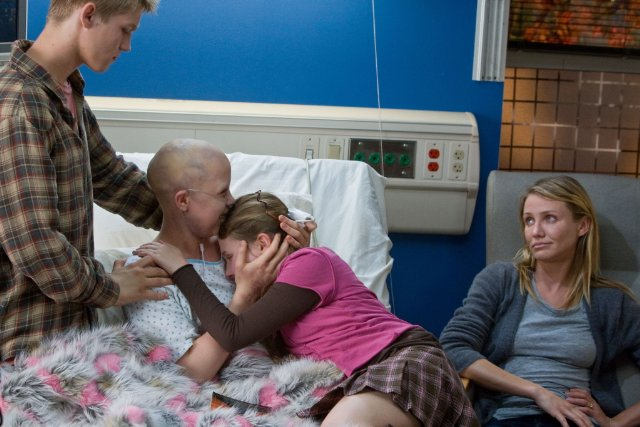
For those who don’t know, My Sister’s Keeper is all about Anna, who’s engineered cells and tissues are saving her older sister Kate’s life from Leukaemia, who sues her family for the rights to her own body. There are lots of moral questions, but mainly it’s about the mother, Sara, the protagonist, who fights to keep Kate alive, damaging her family and sometimes even preventing Kate from positive life experiences, whilst Anna sues not just for the rights to her body, but for Kate’s right to die. The film asks how far we are willing to go to save a loved one; is it right to put the needs of everyone else, including the one we are protecting, second to our need to keep them alive? What I think is wonderful, is how there are no easy solutions, and finally Sara is forced to let Kate go, giving her what she wants, celebrating the good life she’s lived, and finally bringing her family together.

2.    Who are these people?


This question seems to ask about a community, and unless your character is a hermit (but then consider how the community feels about that hermit) they have people in their lives with values. How to Train Your Dragon features a community of tough Viking dragon slayers, and The Firm a community of highflying, intrusive businessmen. My Sister’s Keeper is all about the family unit, and each one is dealing with the care of Kate whilst trying to keep their family together, and it’s through how they go about this that the story and theme unfolds.

3.    What do they want?


Sara wants to keep Kate alive and well, whereas Anna wants to sue her parents for the rights to her own body, until it’s then revealed she, along with her brother Jesse, wants to help Kate to die. Brian, Sara’s husband initially helps with Kate’s treatment, but then he discharges Kate to take her to the beach against Sara’s wishes, showing his allegiance to Anna and Jesse.

Everyone wants something and side under two distinct moral points of view, to let Kate live or die, but overall everyone wants to keep their family together and each go separate ways to achieve it.

4.    What stops them getting it?


The film is based upon the idea that Sara would never allow Kate to die, and Anna has to get the rights to her body to make that decision. We have the scenes in the court room involving Campbell, Anna’s lawyer, and Judge De Salvo, who is dealing with her own grief. I love how the family are all in opposition, but still sit around the dinner table together, attempting to function as best they can as a normal family despite the conflicts bubbling under the surface.

5.    Why should I care?

This is hard question to answer. “It’s my story, of course you should care!” I think it’s about the stakes of the film, what happens if the characters should fail. If Anna doesn’t get the rights to her body she will have to undergo several operations. It’s horrible to think that a child should have to do that, and we care because there is something moral going on here and a person could get hurt.

I also think we care when we empathise with the situation. We don’t like Sara for doing what she’s doing to Anna, but we understand the lengths a mother would go to save her daughter. If a character does something morally wrong yet we get why they are doing it, I think we are gripped. We start to question the way we view the world. What is right or wrong? That’s what a great film or story is supposed to do. Make use reassess the way we view the world, and come out feeling changed ourselves. That’s why we should care, because this film is saying something important.


I thought I’d wrap up with my inspiration to this post. I read an article describing the primary character and secondary characters, with a warning not to reveal too many surprises about the secondary characters as this might distract from the primary character. Although I do agree that we don’t want to dilute the film too much or else it could lose its focus on the protagonist’s journey, we, as writers shouldn’t think in a black and white sense of primary and secondary. All the character’s in My Sister’s Keeper serve the change in Sara’s character through added texture and colour. Even if certain aspects of character don’t make the final cut, it’s good to know all your characters inside out, and to remember that all characters are central to the story with their own unique purpose.

 You can read more about screenwriter, dramatist and director Roger Stennett, on his website 


Thursday, 4 July 2013

The Case of The Station Agent; Do We Always Need a Concrete Goal?

I was once told in a screenwriting workshop in Cologne that characters must always have a visible, tangible goal, the more concrete the better. If she wants to win a contest, she wants to win a medal. If he wants his son back, he wants the custody papers. But what about stories where the character has no goal, such as the Station Agent? This post looks at how this film works without a concrete goal, and how instead of an aimless, wandering narrative, becomes a gripping, emotional drama.

Peter Dinklage, who plays Tyrion Lannister in HBO’s A Game of Thrones, got his first central role in the Station Agent in 2003, a film which focuses solely on the difficulties that being a dwarf has placed upon his character. Fin avoids all social situations, be it riding on the train or going to bars, and when we’re first introduced to his character in a day in the life sequence of him working at a toy store in the city, we gather he only has one friend in the world, Henry, and besides that, keeps himself to himself, and avoids reacting to the many japes people make at his expense. It’s a defence mechanism to keep the bad people out, but has instead distanced Fin from life’s good experiences.

This distancing is Fin’s weakness, his character flaw that needs to change for him to find happiness, and he has no intention of changing any time soon. Spoilers follow!

Henry dies suddenly of a heart attack and, in accordance with his will, the toy shop is closed and its stock liquidated. With noting left, except the inheritance of a small train depot in rural New Jersey, Fin walks (he doesn’t drive or take a train) all the way to his new property in the small town of Newfoundland. Fin could easily keep himself to himself in the city, but in this small, lonely community, Fin has to avoid the advances of two people desperate for his friendship.

To recap, we have this guy, Fin, a dwarf, who would rather walk many miles than take a crowded train, who tries his hardest to avoid Joe, who works the refreshment van right outside the train depot, and Olivia who has recently lost her son, and who, after accidentally running Fin down a few times, tries to apologise to him. Fin is avoiding things (albeit rather actively) rather than trying to get them, but this only works because of the active characters around him.

Olivia sees a bit of her son in Fin, and gradually she and Joe, through their constant advances, and their interest in Fins hobbies, in train watching, and train chasing (which Fin couldn’t do until they came along as he can’t drive) they become close friends.

As in Thomas McCarthy’s second film, The Visitor, around the middle of the film we see our passive hero become active. In the Visitor, Walter, a lonely businessman discovers two immigrants in his apartment, Tarek and Zainab, and lets them stay. He bonds with Tarek over a common interest in music (notice again an interesting hobby forming a bridge of friendship, but one that is central; the music is actually him grieving for his dead wife, as trains form the theme of distancing through how Fin walks the tracks, the right of way as he calls it, as opposed to travelling on trains).

Then, something happens. Tarek is arrested and Walter has to fight to get him released. In the Station Agent, the goal is less concrete, but it's still there. Olivia’s estranged husband comes to visit one morning whilst Fin and Joe are in the house, and after that she ignores them. Fin makes it his mission to get back her friendship. He gets hurt, and hurts others too, and this gives him the push he needed to come into the open and live; he gets drunk in a bar, stands on a bar stool and tells those making japes to take a long, hard look at him.

This film works because of the characters around the protagonist. Olivia has a problem which directly involves Fin (she admits, when Fin saves her from killing herself, that she wanted her son back and was distant from Fin as he reminded her of him), and allows Fin through no fault of his own to cause her hurt. She’s the hero of the film, and without her, Fin wouldn’t change. Joe is great too, because he is lonely and desperately wants a friend.

As drama works when someone wants something and has trouble getting it, a concrete goal lets this build easily, and lets us know if they pass or fail. But I think it’s possible for a film to work without a goal, as long as there are active characters to build conflict, the protagonist has a weakness, and is in a situation that encourages him to embrace his need.

The Station Agent, on IMDB, by Thomas McCarthy (2003)

The Visitor, on IMDB, by Thomas McCarthy (2007)

Here’s a link to The Visitor script. If anyone can find the script of the Station Agent let me know!

Friday, 10 May 2013

When the Cool Character of Your Story Isn’t Your Hero

Sometimes you dream up an amazing character with a really gripping struggle, and then, as I’m sure as happened with the BBC’s latest zombie drama, In the Flesh, you realise they’re not your hero. This post analyses the first episode and looks at how to write a story about an interesting character through the eyes a character you might have overlooked.

Dominic Mitchell’s, In the Flesh, was developed after submission to the BBC Writer’s Room Northern Voices scheme. It became a three-part series, though I felt there needed to be a lot more episodes (unless there’s a season two?), but regardless, the first episode was bit of a gem. Spoilers follow, so if you like you can read the script here as it’s no longer on BBC iPlayer.

Episode one follows Kieren, a Partially Deceased Syndrome Sufferer (PDS), which basically means zombies walked the earth and were then treated with a special drug to restore brain function, controlling their rabid urges, and allowing them to reintegrate into society.

At least, that was the plan. Kieren is sent back to his home in Roarton, where, unlucky for him, the Human Volunteer Force (HVF) is determined to kill zombies, rabid or otherwise. Kieren is forced to hide in his bedroom for fear of his life. This is where Kieren’s sister, Jem, a metal loving teenage badass and respected member of the HVF, takes over the story.

Jem has a meeting with slightly crazed HFV leader, Bill, who states that he will kill any PDS zombie he finds, and as Jem’s family are planning Kieren’s arrival, we get a sense that she’s caught between the values of her HVF buddies and the love she once had for Kieren.

Jem’s goal isn’t very tangible, but she does interrogate Kieren for proof that he is her brother and not just a monster. I suppose she’d like him to be a monster, in a way, because then her HVF buddies were right and she can kill this monster and go back to life as normal.

There’s a fantastic moment when Kieren describes past events that only he could know, and Jem realises in a teary moment that he is her brother after all. Jem’s change is cemented in the climax where the HVF come to kill a PDS suffer on her street, and Jem stays at Kieren’s side with her gun loaded, ready to protect him at all costs, which proves her love for him.

It doesn’t end until the final twist (major spoiler) where Jem witnesses Bill kill a neighbour’s wife (a PDS sufferer) in cold blood, revealing they weren’t after Kieren after all. It is, however, a mirror to what could’ve happened to Kieren, and as we’ve just seen Jem ready to defend him, we know that when she sees Bill do this, she is thinking of him, and is the punch that switches her allegiance and ends the story. Jem changes from hating Kieren to loving him, and from supporting the HVF, to adamantly despising all they stand for.

It feels like it should be Kieren’s story, his struggle to survive when he goes home to possibly the worst place on earth for him to be, but once he goes into hiding, there isn't much else he can do. It’s a world change story, as now Kieren’s sister accepts him, and perhaps in time the rest of the world will too, but it isn’t Kieren driving the story. He does have his own struggle, the same as Jem, but is dealing with his own crisis of whether he is a man or a monster, and I think that’s what makes it work. Jem is the active character who discovers Kieren isn’t a monster, giving Kieren an insight into himself. “If Jem loves me, I can’t be a monster.”

If you have an interesting character you want to be the hero but seems passive, you could try and give them a goal, or follow In the Flesh, and pick another character whose struggle mirrors the interesting character, one that directly involves them, and allow this other character to become the hero and drive the story. Once this new hero has a revelation and changes, the interesting character might get a glimpse of change themselves, and the world might change to one where they can live, even if that change is a small as a sister’s love.

Sunday, 5 May 2013

Getting an Idea Through Re-Writes

I spent the last few weeks writing a two-minute film, but gradually, through re-writes, I saw it morph into a longer, deeper, and hopefully more interesting piece. I had to rely on my own reactions to the script as my usual writing group were busy with their master’s scripts, but I did make some interesting observations, summarised as a sort of self-review guideline at the end of this post. It reminded me of the importance of re-writes, but also how not assuming you know what you’re writing at the start (ten-minute short, sixty-minute drama, feature) can give you the flexibility to develop the best possible story from your initial idea.

My film focused on a fussy guy at a new year’s party who struggles to find a girl to kiss before the countdown ends, and can't even get a kiss from a granny in the end, the joke being that the granny could’ve been good for him. I thought it was a fun idea, but once it was written, I found it really dull.

I wondered if I had too much going on, until after I had written an article about empathy, I realised it was boring because I had no empathy for the main character. He objectified women and got what he deserved; not a character I could follow or feel anything for.

For draft two, I made the hero insecure about the way he looked, which made him a bit of a cliché geek up against a handsome lad, but it did make for a more interesting read. This version came crashing down, however, because the story of a guy trying and failing to get a kiss became repetitive and unsurprising. I made him kiss the old woman in the end, but it didn’t mean anything. A guy struggles to get a kiss, and gets one, and that was about it.

I remedied this by focusing on what was interesting, which to me, was an older woman in a nightclub. I fleshed out her character, focusing on her strengths and weaknesses, and made the story about the hero (Chris) having a relationship with this older woman (Linda), but had Chris worried about being with her because of what his family and friends might think. Chris kissed another girl in an attempt to move on from Linda, and Linda saw him and ran into the bathroom, where Chris came in to apologise. It felt nice to set it in a small location after an event had occurred, and allowed me to surprise the audience when Linda opened the cubicle door and revealed her age.

Thanks to feedback from a trusted friend, I realised my theme was unsatisfying. Linda had to stop partying so hard, and in the end, became friends with Chris, which was basically saying when you get old you can’t act young or have a relationship with your true love if they’re too young for you.

My final version had Chris too afraid to reveal his true self to the world (and thus clubs to meet girls when he’d rather be out hiking and writing poems) and therefore is unable to accept being with Linda, and ends with a revelation that if he did have Linda, he wouldn’t be alone.

My final problem was even though Chris realises his true fear is being alone, he was still too afraid to choose Linda over friends and family. I ended up playing off the 'Linda-as-older' idea that she'd been clubbing so hard (in an attempt to not become what she perceived as a 'dull old-person') that she became exhausted and fainted. Chris realised he couldn't live without Linda and openly loved her at the end. It felt good, but I had trouble bringing in this new element without having set it up, and it made me wonder where to open the film.

It’s great to have flexibility, but there comes a time to decide upon the best path to take. I’m not sure how interesting it’d be if I began at the start of their relationship, and really I'm just starting to get the idea, but re-writing the script has shown me what has and hasn’t worked, and brought it to the point where I feel I have something to say. So if you feel you have an idea worth telling, tell it, but don’t be afraid to change and re-write.

Gareth’s Self-Review Check-list

  • If your script is dull, perhaps it’s because we have no empathy for your hero.
  • If your story feels unsurprising or unsatisfying, perhaps you’re being repetitive or aren’t expressing a theme.
  • Perhaps you can find a theme by focusing on what is interesting in your story.
  • Shorts work well with fewer locations, when they start after an event has occurred, and are really interesting with a ‘surprise’ at the end (although one organic to the story).
  • Have you thought about the resolution of your story, and what it might mean?
  • Have you introduced a rouge element half-way thorough? Perhaps it needs to be set-up to not confuse the audience and create anticipation e.g. if we knew Linda was suffering from exhaustion, it would play out the whole scene until she faints.